Sacred Music
Saint Yared
In the 6th century, a young boy named Yared watched a caterpillar climb a tree. It fell. It climbed again. It fell again. Seven times it fell. On the eighth attempt, it reached the top.
Inspired by this persistence, Yared returned to his studies and became one of the greatest geniuses in Christian history. He composed the entire system of Ethiopian sacred music — a musical tradition that has remained virtually unchanged for over 1,500 years.
Yared created the three modes of sacred chant, developed a notation system, and composed thousands of hymns for every liturgical season. Legend says that when he first sang his compositions in the presence of the king, he was so enraptured that he did not notice when the king's spear pierced his foot.
His music is not mere melody — it is ዜማ (zema), sacred sound, the voice of heaven made audible. Every Ethiopian church to this day chants the words and melodies Yared received by divine inspiration.
The Three Modes
ሦስት ዓይነት ዜማ
The foundational mode, used for ordinary days and regular liturgies. Measured, steady, and contemplative — the bedrock of sacred chant.
The sorrowful mode, used for fasting and mourning. Slow, mournful, penitential — the music of the wilderness and the cross.
The joyful mode, used for feasts and celebrations. Uplifting, celebratory, triumphant — the music of resurrection and glory.
Sacred Instruments
የቅዱስ ሙዚቃ መሣሪያዎች
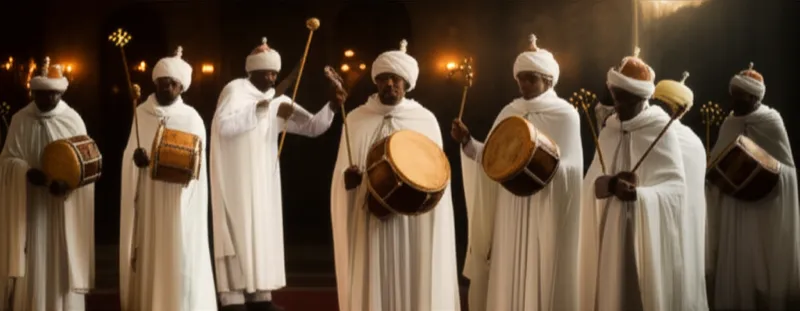
The large drum, the heartbeat of the liturgy. Its deep rhythm echoes through the church, grounding the chant and calling the faithful to worship.
The sistrum, an ancient rattle identical to those used in Pharaonic Egypt. Its metallic shimmer accompanies processions and high feasts.
The prayer staff, a T-shaped stick that supports priests and deacons during services that last up to four hours. A symbol of endurance and devotion.
Aquaquam — Liturgical Dance
አቋቋምWorship in the Ethiopian Church is not a passive experience. During major feasts, priests and deacons perform the aquaquam — a sacred, rhythmic dance that involves swaying, stepping, and full-body movement in unison.
This is not performance. This is embodied prayer. The body becomes an instrument of worship, moving to the beat of the kebero, the shimmer of the tsenatsil, the rise and fall of the chant. Services can last up to four hours, and the aquaquam never falters.
The dance recalls King David leaping before the Ark (2 Samuel 6:14). It is joy, reverence, and surrender — the whole person offered to God.
Qine — Wax and Gold
ቅኔEthiopian sacred poetry follows the tradition of qine — a form of double-layered meaning known as "wax and gold." The surface meaning (wax) is clear and accessible. The hidden meaning (gold) is deeper, theological, often requiring insight and contemplation to uncover.
A master of qine can compose a single line that praises a saint on the surface while simultaneously conveying a profound doctrine about Christ, the Trinity, or the mystery of salvation. It is the art of sacred wordplay, spiritual wit, and theological depth woven into rhythm and rhyme.
Qine is recited in sermons, chanted in hymns, and treasured as a high art form. To understand qine is to enter into the mind of the Church — playful, profound, and endlessly rich.
The Divine Liturgy — Qiddase
ቅዳሴThe Qiddase (Divine Liturgy) is the pinnacle of Ethiopian worship. It lasts between 2 to 4 hours, conducted entirely in Ge'ez, the ancient liturgical language. Every word is chanted. Every gesture is sacred. Every moment is deliberate.
The priest uses one of the 14 anaphoras (eucharistic prayers), each with its own theological emphasis and poetic structure. The deacons respond in harmony. The congregation stands throughout — no pews, no sitting. This is worship as participation, not spectation.
The liturgy is not rushed. Time bends. Heaven and earth meet. The Body and Blood of Christ are consecrated, veiled, and distributed with reverence. Those who partake have fasted — no food or drink from midnight until the moment of communion.
This is not a Sunday service. This is the meeting of the cosmos with the Creator, and it happens every single day in Ethiopian churches around the world.